• Service Internet

    HTML stands for HyperText Markup Language. HTML  is the backbone of every web page you see online. It provides the structure and meaning of content by defining elements like headings, paragraphs, images, and links. Without HTML, web browsers wouldn’t know how to display text, media, or navigation.
  • HTML Hyperlinks

    HTML Hyperlinks HTML hyperlinks are the clickable connections that move you from one resource to another on the web. They’re created with the small but powerful <a> (anchor) tag and its href attribute, which points to the destination you want to open—another page, a section on the same page, an…

  • HTML Lists

    HTML Lists If you’re learning HTML, one of the first building blocks you’ll use over and over is the HTML list. Lists help you group related items, outline steps, and make content easier to scan—whether you’re writing instructions, menus, or article summaries. In this guide, you’ll learn how to create…

  • HTML Document Structure

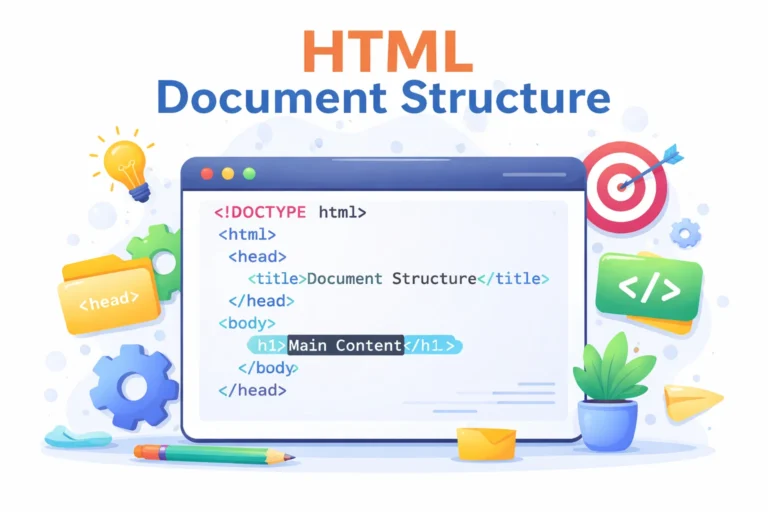
    Every web page begins with a solid structure. The HTML document structure defines the skeleton of any webpage—from the declaration () that tells browsers it’s HTML5, to the , , and elements that organize content and metadata. Understanding this foundational layout helps developers build clean, organized, and browser-friendly websites.

  • What is HTML?

    HTML (HyperText Markup Language) is the standard language for creating web pages. It structures content using tags to define elements like headings, paragraphs, links, images, and more. Think of HTML as the blueprint that tells browsers how to display text and multimedia on the web. Without HTML, the internet as we know it wouldn’t exist.